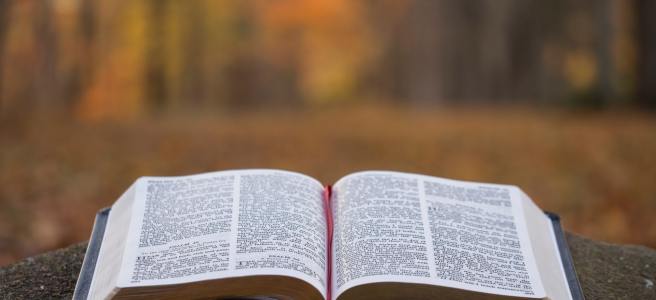
10 Names that Are Surprisingly in the Bible

We all know that names like John, Matthew, and Paul can be found in the Bible, but what about the name of some beloved cartoon characters or a well-known billionaire? Churchgoers of any denomination are probably familiar with the long genealogies that are read at Christmas services, which are among the many that are found throughout the Bible. With so many names, we are bound to find some unexpected ones!

10. Chloe

A name that would strike most as being purely American, “Chloe” has deep scriptural roots. In the opening chapter of the First Letter to the Corinthians, Saint Paul urges his audience to maintain their Christian unity and stop forming rival factions based on which apostle had baptized them. Though Paul was not in Greece when he wrote this letter, he learned the intel on the Corinthians from informants “of the house of Chloe” (1 Cor. 1:11). House churches were common in early Christianity when the new religion was outlawed throughout the Roman Empire and persecution was fierce. House churches allowed Christians to meet in secret at a nondescript location. It is likely that Chloe was a wealthier Christian Corinthian with a house big enough to double as a church.

9. Susanna

This is a name that we typically do not expect to find alongside names such as Jehoshaphat, Zerubbabel, and Eliakim. Before the name was popularized in the old American folk song, “Oh! Susanna,” it was recorded in the New Testament. In the eighth chapter of the Gospel of Luke, we are introduced to some female followers of Jesus. In addition to the Twelve Disciples, these women were instrumental in facilitating the ministry of Jesus by providing necessary financial and material support. The named women include Susanna, Joanna, and the more well-known Mary Magdalene. Not much is known about Susanna’s life, and other than this brief mention in the Gospel of Luke, Susanna does not appear anywhere else in the Bible.

8. Delilah

Another biblical name that has been popularized through music is Delilah. Mostly recognized from the Plain White T’s 2006 hit single, “Hey There Delilah,” this name can also be found in the Book of Judges! Delilah is the woman who persuaded Samson, the last Judge of Israel, to reveal the secret of his great physical strength. In the 16th chapter of the Book of Judges, Delilah is tasked by the leaders of the Philistines with the objective of weakening Samson so they could have an advantage over the Israelites. Samson, who had fallen in love with Delilah, initially lies to her about the source of his strength, but after being continually pestered for the truth, Samson reveals that it is his locks of hair that gives him his strength. Armed with his knowledge, Delilah has Samson’s head shaven in his sleep. The Philistines would go on to imprison Samson, who would eventually die during his escape from prison after his hair grew back and his strength returned.

7. Phoebe

Before there was Phoebe Buffay from Friends, there was Phoebe from the Letter to the Romans. The last chapter of Saint Paul’s rather long epistle to the Christians in Rome contains a litany of people that Paul personally greets. Before he mentions anyone else, Paul commends the actions of one Phoebe, a minister of the church in the Greek city of Cenchreae. She is described as a benefactor to Paul and many other Christians, which emphasizes the important role that many women in early Christianity had in providing for the material needs of the Church.

6. Jair

The name Jair might ring a bell for some of us, as it is the first name of the current President of Brazil, Jair Bolsonaro. President Bolsonaro is known for his roller coaster of a presidential campaign when he was stabbed in the abdomen at a campaign rally in Minas Gerais and lost nearly 40% of his blood. He has also made international headlines for some controversial comments, such as when he threatened to punch a journalist after being asked about corruption allegations. While this Jair is fairly well-known, there is another whose story can be found in the Bible.

Like Jair Bolsonaro, the Jair of the Bible was also a political leader, albeit without the stabbing incident or the fiery temperament. The 10th chapter of the Book of Judges describes him as one of the “judges” who ruled Israel for a long tenure of 22 years. Being one of the “minor judges,” we do not know much about him, other than the fact that he had a wealthy and influential family that was charged with ruling over 30 Israelite cities.

5. Cornelius

One of the fancier names of the English language is older than we might think. In the 10th chapter of the Book of Acts, Saint Peter meets and baptizes Cornelius, a Roman centurion whose household would become the first Gentile converts to Christianity. In this chapter, Cornelius sees a vision of an angel ordering him to find Peter and bring him to Caesarea, where Cornelius was living at the time. Around the same time, Peter sees a rather obscure vision that would eventually encourage him to broaden his missionary efforts beyond the Jewish community to include Gentiles. Peter is eventually brought to Caesarea, where he would preach to the house of Cornelius and baptize them.  

4. Phineas

Watching Phineas and Ferb was probably the first time many of us encountered the name “Phineas,” but did you know the ancient Israelites recorded that same name thousands of years ago? In the sixth chapter of the Book of Exodus, a genealogy is listed, but this time for Moses and Aaron, the two Israelite leaders who were instrumental in guiding the freed Hebrew people away from Egypt. At one point, the genealogy reaches Aaron and mentions his descendants, one of which is his grandson Phineas, who would be among the first of the priestly class that would descend from Aaron and play a crucial role in the religious services of the Temple of Jerusalem.

3. Candace

Why not another character from Phineas and Ferb? What is interesting about the name Candace is that it is not a name so much as it is a political title. In the eighth chapter of the Book of Acts, we learn about the missionary activity of Philip the Evangelist, one of the seven deacons who were ordained in the sixth chapter of Acts. At one point, Philip encounters an Ethiopian eunuch who was a royal official of the court of the Candace, which was the title of the queen of the Nubians of Ethiopia. Philip hears the eunuch reading a passage from the Old Testament out loud and notices that he is having trouble understanding it. Philip would eventually baptize the eunuch after explaining the scripture passage and relating it to the life and purpose of Jesus. The eunuch, whose name we do not know, would then travel back to Ethiopia as one of Africa’s first Christians!

2. Elon

Elon Musk seems to have his fingerprints on everything. PayPal, SpaceX, Tesla, and SolarCity can all thank our generation’s Thomas Edison in some way for their existence. While the billionaire Elon may have all the attention right now, there was another Elon who was famous enough to have is name written in the Bible. In the 12th chapter of the Book of Judges, we encounter a list of minor judges. One of these judges, Elon, ruled Israel for a decade and was eventually succeeded by Abdon. Not much is known about his life, other than his political leadership and that he was of the Tribe of Zebulun.

1. Barack

You might be surprised to find out that the first name of the 44th President of the United States can be found in the Bible. In the fourth chapter of the Book of Judges (again?), the prophetess Deborah summons a man named Barack (in some translations it is spelled “Barac” or “Barak”) to raise an army against Jabin, a Canaanite king whose forces were occupying the land of the Israelites. Barack obeys Deborah’s request and raises an army, which would eventually defeat the forces of Jabin, who would later be killed himself.

Photo credit: https://unsplash.com/photos/9zsHNt5OpqE

Year C | 6/16/19 | John 16:12-15

“I have much more to tell you, but you cannot bear it now. But when he comes, the Spirit of truth, he will guide you to all truth. He will not speak on his own, but he will speak what he hears, and will declare to you the things that are coming. He will glorify me, because he will take from what is mine and declare it to you. Everything that the Father has is mine; for this reason I told you that he will take from what is mine and declare it to you.”

John 16:12-15 (NABRE)

We often don’t give the Holy Spirit the attention He deserves.

We see in this passage a presentation of the Holy Trinity, one God in three distinct, divine Persons. For as transcendent as God is, He is also profoundly immanent. We have a God that is not some dead notion or a nice but useless thought, but is instead very much alive and powerful and also so very personable. He desires intimacy with us, not because He needs us, but out of His unfathomable love. Intimacy with the divine is possible and is very much aligned with reality. Jesus promises the guidance of the Holy Spirit in this passage. When we think of guidance from human beings, we think of that advice and encouragement we receive from people with which we have a trusting and intimate relationship. If us human beings can be of such great consolation to each other, how much more can God the Holy Spirit console us in deep intimacy and loving guidance?

Thank you for reading. Peace.

Year C | 6/9/19 | John 20:19-23

On the evening of that first day of the week, when the doors were locked, where the disciples were, for fear of the Jews, Jesus came and stood in their midst and said to them, “Peace be with you.” When he had said this, he showed them his hands and his side. The disciples rejoiced when they saw the Lord. [Jesus] said to them again, “Peace be with you. As the Father has sent me, so I send you.” And when he had said this, he breathed on them and said to them, “Receive the holy Spirit. Whose sins you forgive are forgiven them, and whose sins you retain are retained.”

John 20:19-23

A fitting reading for Pentecost Sunday.

It is curious that the risen Jesus still has the wounds He sustained during the Crucifixion. Baffling as it may be at first, it becomes clearer why this would be the case when we take into account what happens in this passage. Jesus bestows the Holy Spirit on the disciples in the upper room to authoritatively and effectively forgive sins. As a Catholic, I believe that this authority to forgive sins is exercised in the Sacrament of Confession. The Apostles received this authority from Jesus and it has since been passed down to their successors (the bishops) and those successors’ collaborators (the priests). Jesus shows them the nail marks in His hands and the lance wound on His side before He confers the Spirit. In doing so, Jesus demonstrates that His unfathomable and inexhaustible mercy, which was displayed on the Cross when He suffered and died for the forgiveness of sins, is the same mercy that will be exercised through the missionary ministry of the Apostles that would take place after Pentecost.

What a wonderful gift we have in Confession.

Thank you for reading. Peace.

Year C | 5/26/19 | John 14:23-29

Jesus answered and said to him, ” Whoever loves me will keep my word, and my Father will love him, and we will come to him and make our dwelling with him. Whoever does not love me does not keep my words; yet the word you hear is not mine but that of the Father who sent me. I have told you this while I am with you. The Advocate, the holy Spirit that the Father will send in my name — he will teach you everything and remind you of all that [I] told you. Peace I leave with you; my peace I give to you. Not as the world gives do I give it to you. Do not let your hearts be troubled or afraid. You heard me tell you, ‘I am going away and I will come back to you.’ If you loved me, you would rejoice that I am going to the Father; for the Father is greater than I. And now I have told you this before it happens, so that when it happens you may believe.

John 14:23-29 (NABRE)

The Holy Trinity works to guide each believer to Heaven.

Jesus comes from the Father, commands us to love one another as He (Jesus) has loved us, and then has the Holy Spirit sent by the Father in the name of the Son (Jesus) to guide us in our walk of faith.

On this walk, the Holy Spirit reminds us of what we have learned from Jesus. After giving His disciples the promise of the Advocate, Jesus leaves them with His peace. It is interesting that this bestowal of peace comes immediately after the promise of the outpouring of the Spirit. There is a connection between walking along the Way, according to the Truth, and towards everlasting Life and an experience of an otherworldly peace. This is the peace of Jesus Christ. It is found in the stability of living as Christ would want us to live. In conducting ourselves in this manner with the help of powerful divine grace, we experience a detachment from the desirability of sin, which ultimately enslaves. This peace is not bound to worldly peace, which often comes from an absence of war, financial security, and physical health. These are certainly goals to achieve, but here is something so beautiful about the peace of Christ: it can be experienced by those who do not experience a privileged life of socioeconomic prosperity and stability. The poor people of war-torn countries can and do experience the peace of Jesus in their lives. It is available to all, even to those who do not live in ideal situations. Jesus has a special love for the socioeconomic poor. All life is valuable on an inestimable scale. God shows no partiality.

Thank you for reading. Peace.

Year C | 5/12/19 | John 10:27-30

My sheep hear my voice; I know them, and they follow me. I give them eternal life, and they shall never perish. No one can take them out of my hand. My Father, who has given them to me, is greater than all, and no one can take them out of the Father’s hand. The Father and I are one.

John 10:27-30 (NABRE)

Jesus solemnly utters a statement of divinity. We have God as our shepherd!

Jesus uses figurative language to artistically express deeper truths throughout the Gospels. Pastoral language is found throughout Holy Scripture, such as in the Book of Psalms, the Book of Ezekiel or here in the Gospel of John. Obviously, God wants to emphasize that the attentiveness of His care can be likened to that of a shepherd. So, let’s think for a moment about what shepherds do. Even if you’ve never seen a sheep in person, you can still learn some basics by inference. Shepherds lead, guide, heal, discipline, feed, shelter, and protect their flocks. The sheep have the assurance of a competent shepherd and the company of many other sheep. Already, we can see that God wants us to take in the message that He deeply cares about us. He delights in us and wants to bring us joy and peace, just as a shepherd longs to bring his flock to abundant, tranquil pastures and flowing streams. Such is the care of our God. You can rely on God to help you in whatever situation you are in or in whatever vocation into which He calls you. T r u s t i n G o d ! If mere human shepherds can care so well for their flocks, how much more can almighty, all-good God, who is Love, care for you!

Thank you for reading. Peace.

Year C | 5/4/19 | John 21:1-19

After this, Jesus revealed himself again to his disciples at the Sea of Tiberias. He revealed himself in this way. Together were Simon Peter, Thomas called Didymus, Nathanael from Cana in Galilee, Zebedee’s sons, and two others of his disciples. Simon Peter said to them, “I am going fishing.” They said to him, “We also will come with you.” So they went out and got into the boat, but that night they caught nothing. When it was already dawn, Jesus was standing on the shore; but the disciples did not realize that it was Jesus. Jesus said to them, “Children, have you caught anything to eat?” They answered him, “No.” So he said to them, “Cast the net over the right side of the boat and you will find something.” So they cast it, and were not able to pull it in because of the number of fish. So the disciple whom Jesus loved said to Peter, “It is the Lord.” When Simon Peter heard that it was the Lord, he tucked in his garment, for he was lightly clad, and jumped into the sea. The other disciples came in the boat, for they were not far from shore, only about a hundred yards, dragging the net with the fish. When they climbed out on shore, they saw a charcoal fire with fish on it and bread. Jesus said to them, “Bring some of the fish here you just caught.” So Simon Peter went over and dragged the net ashore full of one hundred fifty-three large fish. Even though there were so many, the net was not torn. Jesus said to them, “Come, have breakfast.” And none of his disciples dared to ask him, “Who are you?” because they realized it was the Lord. Jesus came over and took the bread and gave it to them, and in like manner the fish. This was now the third time Jesus was revealed to his disciples after being raised from the dead.

When they had finished breakfast, Jesus said to Simon Peter, “Simon, son of John, do you love me more than these?” He said to him, “Yes, Lord, you know that I love you.” He said to him, “Feed my lambs.” He then asked him a second time, “Simon, son of John, do you love me?” He said to him, “Yes, Lord, you know that I love you.” He said to him, “Tend my sheep.” He said to him a third time, “Simon, son of John, do you love me?” Peter was distressed that he had said to him a third time, “Do you love me?” and he said to him, “Lord, you know everything; you know that I love you.” [Jesus] said to him, “Feed my sheep. Amen, amen, I say to you, when you were younger, you used to dress yourself and go where you wanted; but when you grow old, you will stretch out your hands, and someone else will dress you and lead you where you do not want to go.” He said this signifying by what kind of death he would glorify God. And when he had said this, he said to him, “Follow me.”

John 21:1-19 (NABRE)

The Easter liturgical season brings out some of my favorite Gospel passages.

In the Gospel of Luke, Jesus calls Peter, James, and John to follow him after they pull in a miraculous catch of fish. Upon seeing the enormous amount, Peter tells Jesus, “Depart from me, Lord, for I am a sinful man” (Luke 5:8). To this, Jesus says, “Do not be afraid; from now on you will be catching men.” A similar interaction takes place here, only now, Jesus has risen from the dead and Peter is still distraught over denying that he knew his beloved Lord. Here we see, once again, the immeasurable Divine Mercy of Jesus. As Jesus said to St. Faustina, mercy is His greatest attribute. Time and again we see Him exercise his mercy in Holy Scripture, and we experience it in our own lives. Jesus does not spare an opportunity to show that He wants to forgive sin and lead us away from its misery.

Not only does Jesus forgive Peter, He also reaffirms the commission he gave to him earlier as the rock upon which the Church will be built (Matthew 16:18). Jesus entrusts his flock to the care of someone of the likes of Peter, who throughout the Gospels is depicted as passionate and genuine yet impulsive and somewhat obtuse.

It is astonishing to think that the Eleven, who went out and fearlessly preached the Gospel throughout the Roman world and beyond and baptized, confirmed, and nourished with the Lord’s Body and Blood so many thousands of people, started out as a ragtag group composed mostly of uneducated fishermen. Matthew (Levi), who worked at a tax office as a collector, was probably the only one of them who could read. You would think that Jesus would select some prominent members of the Sanhedrin to carry out the sacred mission of preaching and evangelizing to the ends of the earth. In our minds, only the best of the best get hired. However, we often forget that God is also a part of the equation. His grace is sufficient (2 Corinthians 12:9). If He calls you to do something, He also will supply you with the divine grace you need to do it. He has a great track record — just read the Acts of the Apostles and see what Peter was able to do with God’s help! Be not afraid of your own sinfulness and weaknesses when God calls you. You have His support. It only takes your willful cooperation.

For Peter, following Jesus meant martyrdom. Jesus hints to his face at what death he would die (crucifixion; i.e. “you will stretch out your hands”). Be prepared for whatever may come as a result of saying “yes” to Jesus. The future is uncertain, but Jesus’ love is certain. He cares deeply, so much so that He went out of His way to feed His friends and disciples breakfast even after accomplishing His salvific work on the Cross and resurrecting from the dead.

Thank you for reading. Peace.

Year C | 4/28/19 | John 20:19-31

On the evening of that first day of the week, when the doors were locked, where the disciples were, for fear of the Jews, Jesus came and stood in their midst and said to them, “Peace be with you.” When he had said this, he showed them his hands and his side. The disciples rejoiced when they saw the Lord. [Jesus] said to them again, “Peace be with you. As the Father has sent me, so I send you.” And when he had said this, he breathed on them and said to them, “Receive the holy Spirit. Whose sins to forgive are forgiven them, and whose sins you retain are retained.”

Thomas, called Didymus, one of the Twelve, was not with them when Jesus came. So the other disciples said to him, “We have seen the Lord.” But he said to them, “Unless I see the mark of the nails in his hands and put my finger into the nailmarks and put my hand into his side, I will not believe.” Now a week later his disciples were again inside and Thomas was with them. Jesus came, although the doors were locked, and stood in their midst and said, “Peace be with you.” Then he said to Thomas, “Put your finger here and see my hands, and bring your hand and put it into my side, and do not be unbelieving, but believe.” Thomas answered and said to him, “My Lord and my God!” Jesus said to him, “Have you come to believe because you have seen me? Blessed are those who have not seen and have believed.”

Now Jesus did many other signs in the presence of [his] disciples that are not written in this book. But these are written that you may [come to] believe that Jesus is the Messiah, the Son of God, and that through this belief you may have life in his name.

John 20:19-31 (NABRE)

A fitting reading for this Feast of Divine Mercy.

Each “block” of text here will be treated separately. There is so much to chew and savor in this account of one of Jesus’ post-Resurrection appearances.

First, we see two effects of the mission and ministry of the Apostles: forgiveness of sins and the peace of Christ, which are bonded with an intimate connection. Jesus makes his disciples ministers of mercy in expressly giving them the authority to forgive sins on earth. To this day, the successors to the Apostles in the episcopacy and their collaborators in the presbyterate forgive the sins of penitents through the Sacrament of Confession. As a Catholic, I am overly appreciative of this wonderful sacrament that Jesus Christ gave to his Holy Catholic Church. Jesus institutes a “tribunal of mercy,” as He describes it to St. Faustina Kowalska, that is such a tangible and concrete way to experience the forgiveness of sins that is granted so generously by our Savior. With the graces that come from this sacrament is the peace of Christ. This is a peace that gives us a preview of what is to come in Heaven. A peace that reminds us of the love with which Jesus showers us constantly. A peace from the Prince of Peace who gives to us abundantly and draws us to blissful communion with Him in his Kingdom. How generous is our Lord and God!

Next, we see the the beautiful patience of the risen Jesus. Thomas is also called “Didymus,” which means “the twin” in Greek. How often do we feel like “twins” of Thomas in our struggle to keep the faith? Jesus is patient with us, just as He was so patient with Thomas, approaching him not with words of condemnation, but with a greeting of peace. Jesus invites Thomas to have faith and helps him come to believe by putting on display his wounds for examination. Our Lord addresses both Thomas and his “twins” in inviting him and those who come to believe in the future to walk by faith and not by sight (2 Cor. 5:7).

Finally, we see another plain invitation to come to believe and accept a life lived in gratitude for and reliance on the grace and peace of our God.

Thank you for reading. Peace.

Year C | 4/22/19 | John 20:1-9

On the first day of the week, Mary of Magdala came to the tomb early in the morning, while it was still dark, and saw the stone removed from the tomb. So she ran and went to Simon Peter and to the other disciple whom Jesus loved, and told them, “They have taken the Lord from the tomb, and we don’t know where they put him.” So Peter and the other disciple went out and came to the tomb. They both ran, but the other disciple ran faster than Peter and arrived at the tomb first; he bent down and saw the burial cloths there, but did not go in. When Simon Peter arrived after him, he went into the tomb and saw the burial cloths there, and the cloth that had covered his head, not with the burial cloths but rolled up in a separate place. Then the other disciple also went in, the one who had arrived at the tomb first, and he saw and believed. For they did not yet understand the scripture that he had to rise from the dead.

John 20:1-9 (NABRE)

Easter is upon us.

This account of the empty tomb contains a gradual discovery. First, Mary of Magdala only sees the moved stone. Next, John arrives at the tomb but does not enter. Peter gets there and immediately goes inside. Finally, John joins him in examining the tomb. The ordeal unfolds slowly despite its inestimable significance for humanity. We often reflect upon the Resurrection of Jesus with the goal of searching this glorious mystery for some personal application, and rightly do we do this. What is the lesson for me, especially given my circumstances? What might God be trying to tell me through this part of Holy Scripture? Approaching this empty tomb narrative with that analytical framework in mind, we come to notice that God often works with us in this slow, gradual manner. Easter is a time to leave to God those burial cloths and head wraps that have kept us bound in the tomb, but we must remember that we cannot accomplish this on our own. Given that, we must also keep in mind that sometimes such positive change only occurs slowly. We humans don’t usually like rapid change. We would rather ease ourselves into the water. We should not be surprised if during this Easter season we notice that God is helping us out of entanglements in certain vices or illnesses of the mind in a slow and gentle manner.

Thank you for reading. Peace.

Year C | 4/14/19 | Luke 22:14-23:56

Note: due to the length of today’s Gospel reading and limited time on my part, I will only provide a reflection on part of the reading.

When the hour came, he took his place at table with the apostles. He said to them, “I have eagerly desired to eat this Passover with you before I suffer, for, I tell you, I shall not eat it [again] until there is fulfillment in the kingdom of God.” Then he took a cup, gave thanks, and said, “Take this and share it among yourselves; for I tell you [that] from this time on I shall not drink of the fruit of the vine until the kingdom of God comes.” Then he took bread, said the blessing, broke it, and gave it to them, saying, “This is my body, which will be given for you; do this in memory of me.” And likewise the cup after they had eaten, saying, “This cup is the new covenant in my blood, which will be shed for you.”

Luke 22:14-20 (NABRE)

Behold, the timeless institution narrative.

As we begin Holy Week, we are reminded of the first instance in which the bread and the wine of the Passover meal become for us the Body and Blood of the Lord Jesus Christ. Both the context and obviously the meaning of this celebration of profound mystery are paramount features of this passage.

Jesus gives us the Eucharist within the setting of a Passover meal on the day before he suffered death on a cross for the forgiveness of sins. This is important to note. Temporally, the age of the patriarchs and prophets is behind Him, and ahead of him is the time in which Jew and Gentile alike will adore Him and celebrate His Paschal Mystery until His return at the Parousia. The bread-and-wine offering of Melchizedek and the manna of the desert prefigure this moment. Jesus takes the bread and the wine and transforms them into the appearances under which He is present in totality so as to provide for His faithful a manner by which they may eat His flesh and drink His blood to have life within them (John 6:53). Jesus gives us Himself, the Bread of Life, to eat for our spiritual and physical nourishment. Recognizing our immense frailty and the fact that we are entirely incapable of loving God and our neighbor without working with His grace should motivate us to receive, in the Eucharist, the very God who draws us to Himself. What a mystery! As Catholics, we have such a great gift. We have a tremendous need for the grace of our Lord Jesus Christ. This sacrament, the Holy Eucharist, is an abundant source of such grace.

This passage also reminds us of our own call to be self-giving in our love for God and our neighbor. Are we not to learn from and apply in our lives the teachings and example of Jesus? In giving us Himself in the Eucharist, Jesus demonstrates how we ought to live for God and our neighbor. Love is expressed ― it does not merely reside within the confines of our hearts; rather, it motivates us to do something out of that love. Jesus so obviously gives Himself for others on the cross and in the Eucharist. He makes it clear that love involves a giving of oneself. Otherwise, it would not be love. Our culture, which is the product of the decisions of us individuals, needs to be more “eucharistic,” as it were. This is especially true in the realm of sexuality and romantic relationships. Perversions such as abuse, pornography, or shattered homes are an ugly result of a lack of self-giving. Practically, self-control, compassion, empathetic response, self-reflection, humility, mercy, recognition of and respect for the inestimable dignity and value of each person ― these things bring life and light and only build up the other. Take away these gifts of self and you get the heap of junk that we see today. It’s an accumulation of the bad decisions we make as individuals. It is so important to be reliant on God’s grace so that we may imitate Jesus Christ every day.

What a Savior! He died for our liberation and desires intimacy with us, so much so that He gives of Himself for us to eat so that He may remain in each of us and each of us in Him (John 6:56).

Thank you for reading. Peace.

Year C | 4/7/19 | John 8:1-11

Jesus went to the Mount of Olives. But early in the morning he arrived again in the temple area, and all the people started coming to him, and he sat down and taught them. Then the scribes and the Pharisees brought a woman who had been caught in adultery and made her stand in the middle.

They said to him, “Teacher, this woman was caught in the very act of committing adultery. Now in the law, Moses commanded us to stone such women. So what do you say?” They said this to test him, so that they could have some charge to bring against him.

Jesus bent down and began to write on the ground with his finger. But when they continued asking him, he straightened up and said to them, “Let the one among you who is without sin be the first to throw a stone at her.” Again he bent down and wrote on the ground. And in response, they went away one by one, beginning with the elders. So he was left alone with the woman before him. Then Jesus straightened up and said to her, “Woman, where are they? Has no one condemned you?” She replied, “No one, sir.” Then Jesus said, “Neither do I condemn you. Go, [and] from now on do not sin any more.”

John 8:1-11 (NABRE)

What did Jesus write on the ground?

Mercy is something we both give and receive. It can be rather difficult to do either, but without mercy, this would be a sad world.

This passage reads like a parable in a way. Jesus’ real-life interactions are teaching moments for us, too. Given this passage’s theme of mercy, it is especially interesting that it starts off with a brief note that before he came to the temple area, Jesus went to the Mount of Olives. We are given no reason as to why he did this, and immediately after the trip is mentioned, the scene shifts. It is worth remembering that the Mount of Olives* is where Jesus experienced immense agony before his arrest and eventual death on the cross for the forgiveness of sins. The inclusion of this note is fitting given what happens between Jesus and the woman caught in adultery.

To the scene at the temple area. The unmerciful scribes and Pharisees intend to take up stones with which to execute the adulterous woman. The refusal to forgive (or even to have the willingness to do so) opens chasms between people, and from a distant vantage point, we see that each of our grudges makes up a lot of the cracks that fragment society. Plainly speaking, to not be merciful, especially in close relationships, is to drive people apart. This also comes from a place of ingratitude. What does it say about us when we refuse to have a merciful outlook after we have received such an abundance of mercy from God? Our experiences of being forgiven both by God and our fellow man should challenge us to be merciful to others because we need forgiveness just like any other sinner! Out of joyful gratitude and an honest view of ourselves we should forgive.

Thank you for reading. Peace.

*A special thanks to the maps section of my copy of the Bible (The Catholic Study Bible, 3rd Edition) for helping me to clarify that the Garden of Gethsemane is located on the Mount of Olives.